
A humor event occurs whenever an observer finds something funny. Humor events, even at their simplest, are considerably more complex than is generally recognized. Consider this excerpt from the 1980 disaster parody movie Airplane!:
Dr. Rumack: Can you fly this plane and land it?
Ted Striker: Surely you can’t be serious.
Dr. Rumack: I am serious, and don’t call me Shirley.
Alternatively, the same joke as a set of screencaps:
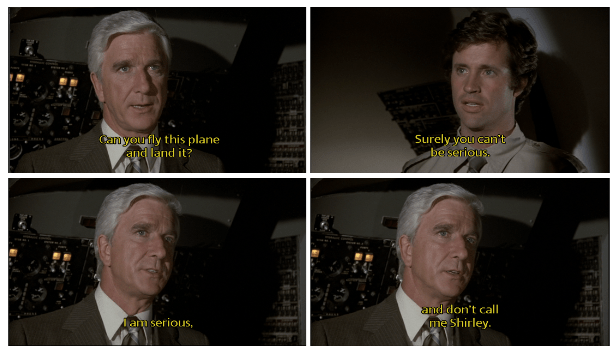
A brief set of initial observations:
- It’s humor, and in particular comedy (humor as entertainment)
- It’s a joke (crafted verbal humor), and a particular kind of joke known as a gag
- It’s presented first as text-only quotation, then as still visual-only images with written captions. It’s not silent video with captions, or video with audio, or audio alone.
- It’s parody (both the excerpt and the movie as a whole), and in particular a spoof
- It’s wordplay, and in particular a pun
- It’s a figure of speech known as paraprosdokian, and in particular a switcheroo
Beyond external aspects visible to most any observer, the internal personality traits of each observer, cultural preferences, and individual observing circumstance further alter humor detection and response. One observer may have trouble reading the captions. Another may find no humor here given Dr. Rumack’s apparent anger. Another just learning English may miss the pun. Someone from a culture that avoids goofy humor may detect no humor at all. Someone watching this scene on a home TV may be distracted by the sudden barking of a family pet. Doubly so if the animal is a cat.
This example only briefly touches on the full range of humor complexities. The humor phenomenon is like orchestra music, where many instruments contribute to the overall sound. Clash Theory describes each of humor’s instruments and how they in turn contribute to the full humor experience.
Return to Introduction
Continue to Clash Theory
 Why Funny Is Funny